Materialist Dialectics and Dynamical Systems
How the Mandelbrot Set and other Dynamical Systems represent advanced, formalized Materialist Dialectics and what that means for 21st Century Scientific Socialism


The Mandelbrot Set
Development, Stability, and Chaos
The Mandelbrot set may be the most well-known Dynamical System. For those who aren’t familiar, the Mandelbrot set represents a recursive iterated equation projected onto the complex plane. To create the set, an initial value on the plane is plugged into the equation, then the solution is plugged back into the equation again, and so on. The area in black represents those initial values that, when iterated, never expand toward infinity. If an area has color, that means it does expand toward infinity. The color gradient represents how quickly an initial value expands toward infinity based on how many iterations it requires to do so. The dark blue, far from the center, expands in value quickly with very few iterations, while the brighter colors surrounding the black areas require many more iterations for their value to increase significantly.
To better understand, imagine a simplified version of the equation: x’=(x^2)-1. If you select an initial x-value of 5, then x’ equals 24. Plugging that back into the equation, the second solution is 575. The third solution is above 30,000. Obviously, this will very quickly expand toward infinity. The initial value of 5 would therefore be represented by dark blue.
Now, imagine you selected an initial value of 1. The first solution would be 0. The second solution would be -1. The third solution would be 0. The fourth solution would be -1. And so on. Obviously, this value will never expand toward infinity. It is a stable iteration, and the initial value of 1 would therefore be represented by black.
Where the Mandelbrot set gets really interesting, though, is on the edges between stability and chaos. This is where its famous fractal patterns occur. These edges have depth that is literally infinite. This is where development is visible: the patterns that illustrate the relationship between stability and chaos are in flux and change with every zoom. They are almost always, however, strikingly beautiful.

A screenshot from somewhere deep within the Mandelbrot Set.
You can experiment with how these iterations unfold on Desmos, and there are several different Mandelbrot viewers in which the set can be explored (note that even with advanced computing, it is impossible to render the full set because it is infinite).
Materialist Dialectics
Lenin described dialectics as “the doctrine of development in its fullest, deepest and most comprehensive form.”1 Engels described dialectics as “nothing more than the science of the general laws of motion and development of nature, human society, and thought.”2 Materialist dialectics, in contrast to idealist dialectics, give primacy in development to material reality, rather than human thought.
Note: I have chosen to use “materialist dialectics” rather than “dialectical materialism” to avoid conflation with the Western Marxist tradition developed by Lukács et al., which posits (incorrectly, in my view) that dialectical materialism only applies to social development, not natural development.
The Three Laws of Materialist Dialectics
Materialist Dialectics is best explained through its three laws. These are contradiction (the interpenetration and unity of opposites), the quantity-to-quality transition, and the negation of the negation.
Contradiction (The Interpenetration and Unity of Opposites)
Lenin said that the interpenetration and unity of opposites “embodies the Essence of dialectics.”3 Contradiction is the engine of development in materialist dialectics. It refers to the opposing forces that compel development within all things and between all things that interact. For example, contradictions between and within atoms are what lead them to organize into molecules. Contradictions within and between those molecules cause them to organize into (among other things) cells. Contradictions within and between cells cause them to organize into (among other things) human beings. And contradictions between and within human beings cause them to organize into (among other things) societies.
Mao said that “without contradiction nothing would exist.”4 This pithy statement reveals what it means for contradiction to be the engine of development: any individual thing can only exist in contrast to something else. Something, for example, cannot exist without nothing, and vice versa. If there were no such thing as nothing, then there could be no such thing as something. Similarly, one could say that the individuality of every individual thing comes from that which it is not.
Concrete examples of the engine of development abound. From a socialist perspective, the most well-known example may be the contradiction between class interests that drive the development of a capitalist society. Consider also the contradiction between the interests of core countries and peripheral countries in the imperialist world-economy. A similar dynamic, the Predator-Prey Dynamical System, will be discussed more later.
In the natural world, one could consider the motion of bodies in space. The movement of the celestial bodies of our solar system is defined by the contradiction between their momentum, which compels them to continue on a straight line tangential to their actual orbit on the one hand, and gravity, which attracts them directly toward each other on the other. This contradiction is famously how Kepler and later Newton were able to derive the mathematics of orbital motion.
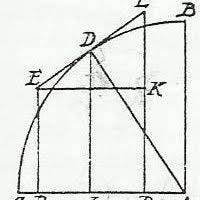
One of Newton’s diagrams on orbital motion from Principia
Importantly, contradiction (and materialist dialectics generally) is itself characterized by constant motion. Engels said that “motion is the mode of existence of matter.”5 He said this long before Einstein proved it in 1905 when he identified that Brownian Motion was caused by atomic movement.
Note: Brownian Motion and its application in social sciences is an excellent example of how contradiction drives development in both the natural and social worlds. More Marxists should endeavor to understand this phenomenon.
The Quantity-to-Quality Transition
Engels said that “in nature, in a manner exactly fixed for each individual case, qualitative changes can only occur by the quantitative addition or subtraction of matter or motion (so-called energy).”6
Quantity-to-quality transitions can be divided into two types. In one case, the change in quality is somewhat commensurate with the change in quantity. For example, as a hot cup of tea decreases quantitatively in temperature, its quality of “hot” decreases concomitantly. In another, more interesting case, a major qualitative change can occur suddenly as a result of accumulated quantitative changes. If the same hot cup of tea continues cooling, it will rather suddenly undergo a phase transition from liquid to solid after it crosses the quantitative threshold of 0 degrees Celsius.
A social example of this is identified intuitively: revolution. In world history, many transitions from feudalism to capitalism, or from slavery to capitalism, or from capitalism to socialism, happened quite suddenly through a revolutionary process. However, it would be a mistake to assume that the conditions that created these revolutions also emerged quite suddenly. Instead, in most cases, these conditions (for example, wages, rent, food prices, labor time, birth and death rates, etc.) built up over time, trending on average in a certain direction at a certain pace. Nonetheless, even if these conditions only change gradually and never suddenly, they can still precipitate a revolutionary uprising if they cross some previously unknown critical threshold.
This second, more interesting case has been the subject of a modern field of scientific research known as catastrophe theory. Imagine a small pile of sand. If one adds a single grain to the top of the pile, the pile will grow in size by the amount of a single grain of sand. Except this is not always the case. Every once in a while, an additional grain of sand will instead cause an avalanche to occur, in which a large portion of sand collapses off the pile, making the pile smaller rather than larger. This unexpected, non-linear dynamic is the essence of “catastrophe.” It is also the essence of revolution. More Marxists should therefore undertake study in this field.
The Negation of the Negation
This is one of the most important characteristics of development for Marxists to understand. If contradiction is the engine of development, then the negation of the negation is the steering wheel that guides its direction.
To understand the negation of the negation, it is necessary to understand what is meant by dialectical negation. Engels wrote that “Negation in dialectics does not mean simply saying no, or declaring that something does not exist.”7 Instead, that which is negated imbues certain characteristics into whatever negates it; this is what Engels called “sublation.” In other words, the direction of development is not determined randomly, but is instead based on whatever conditions precede it, which themselves are based on prior conditions. The negation of the negation refers to the continued effect on present phenomena by characteristics of previously “negated” phenomena, which themselves were influenced by previously negated phenomena. Math enthusiasts may look at the negation of the negation and see the phenomenon known as recursion.
Natural and social examples can once again be identified. In nature, biomagnification occurs when polluted plants poison apex predators, despite the fact that the predators do not consume the plants. An herbivore negates the polluted plant by consuming it, and the characteristic of pollution is sublated into the herbivore. An omnivore negates the herbivore, and itself becomes polluted. The apex predator then consumes the omnivore, and despite having the most distant relation to the polluted plant, is afflicted by the worst extent of the toxic substance as a result of the negation of the negation. The predator itself may die or be unable to reproduce. The negation of the apex predator will, in turn, affect the development of the omnivore population, which affects the development of the herbivore population, and so on. The negation of the negation continues.
Social examples may again be more intuitive. For example, French colonialism in Africa was negated in the 20th Century—the settlers were largely driven out of African lands and independent governments were established. However, characteristics of colonialism were sublated into these African countries to such an extent that many of them are now neo-colonial countries; they still use French currency, continue to speak French, and continue to have their natural resources exploited by France. Even if neo-colonialism were negated, its characteristics would, to a certain extent, be sublated into the next stage of post-colonial African development. For example, the roads and railways that were constructed during the colonial era would persist, and France would likely remain one of the largest trading partners of these countries.
Note 1: There is some debate among Marxists as to whether all negations are dialectical negations, or whether some negations are indeed “terminal,” as in, there are no further negations to be made. It is my view that—with the limited exception of certain abstract categories such as time and space (which may at some point be negated; these would indeed be terminal negations)—all negations are dialectical, and none are terminal. Even an elephant accidentally crushing an ant with a footstep, for example, will carry some of that ant’s biological matter on its skin for several more steps, which may affect both the stride of the elephant and the development of the land on which it lives. Scientifically-minded readers may recall “the butterfly effect,” which is an important characteristic of chaos and dynamical systems.
Note 2: This is an extremely brief description of Materialist Dialectics. There are a plethora of nuances and important principles not expounded upon here. An excellent and more comprehensive resource for those in pursuit of an intuitive understanding of materialist dialectics can be found here. There is a free version available online, but I recommend purchasing this work to support the authors.
Observing Materialist Dialectics in the Mandelbrot Set and in the Behavior of the Predator-Prey Dynamical System
We shall now examine how the laws of materialist dialectics present themselves in both the Mandelbrot set and another Dynamical System known as the Lotka–Volterra equations, or the Predator-Prey dynamic.
Astute readers will notice that a definition of Dynamical Systems has not yet been provided. A Dynamical System is any mathematical model that describes the development of a system over time according to a well-specified rule. These are most commonly expressed by recursive iteration (i.e., repeatedly inputting the output), as in the case of the Mandelbrot set, or by differentiation. The hot cup of tea that cools at a certain rate, for example, can be described by a well-known dynamical system using differentiation.
The Lotka-Volterra model is used, among other things, to understand the development of animal populations in a predator-prey relationship. In these differential equations, the growth of the prey population is reduced when the predator population grows (due to predation), and the growth of the predator population slows when the growth of the prey population is reduced (due to lack of sustenance).

Lotka-Volterra Visualized
The Negation of the Negation
This will likely be the most intuitive and simple of the three laws to observe in this context. Recursive iteration is nearly synonymous with the negation of the negation. In the case of the Mandelbrot set, even though the initial value is immediately negated and replaced once iteration occurs, the subsequent round of iteration will be based on a value calculated based on that initial value. Every value is sublated into the next round of iteration.
In the case of Lotka-Volterra, the negation of the negation is evident from the behavior of the system: when a large portion of the prey population is negated by the predators, a large population of the predator population is itself therefore negated. Additionally, at any given moment, population growth and decline is determined by the extant population levels, which are themselves the result of prior growth and decline.
Quantity-to-Quality Transition
In the Mandelbrot set, the quantity-to-quality transition can be observed by altering the initial values past the critical threshold, which is the border between chaos and stability. For example (I will use Cartesian coordinates for the sake of simplicity here), if an initial value of (y=0, x=0.264) is selected, then the system will remain forever stable. If, however, an initial value of (y=0, x=0.265) is selected—a difference of 0.001—then the system will explode toward infinity.
Similarly, in Lotka-Volterra, the initial conditions have critical thresholds. All else being equal, an infinitesimal decline in the reproduction rate of the prey can cause the total extinction of the predators in a system that would otherwise be stable.
Contradiction (the Unity and Penetration of Opposites)
In the Mandelbrot set, there could not be order without chaos, and the contradiction between them found at their border is where real development occurs. In Lotka-Volterra, the development of the model is driven by two contradictions—one between predator and prey and one within each population: reproduction rate and death rate.
Rejuvenating Scientific Socialism for the 21st Century
Materialist Dialectics is the science of development. Therefore, it should be observed in all scientific and mathematical descriptions of development, not just in dynamical systems. However, Dynamical Systems—specifically non-linear, non-ergodic dynamical systems with sensitive dependence on initial conditions (these characteristics incorporate Chaos and Catastrophe Theory)—represent the most advanced effort thus far in approximately formalizing developmental processes. Socialists in the 21st Century must endeavor to study and understand these systems if they wish to utilize and enact Scientific Socialism.
If civilization survives, then the remainder of the 21st Century will likely witness the most explosive advances in science and technology in world history. For example, tools will be available to our descendants that will allow them to incorporate immense quantities of information into accurate models of social and natural development. These models may help us predict and prepare for the conditions that lie ahead and aid us in identifying how to best respond to them. If we rigorously create robust models, we will greatly improve our chances of victory in our struggles for liberation, common prosperity, sustainability, etc.
It is lamentable that Western Marxists have largely failed to sufficiently integrate the “hard” sciences into their theories and utilize them to create useful tools that aid us in our struggles against oppression and exploitation. As technological progress occurs and our enemies use technology against us, we too must use it to fight back against our enemies. A major component of this struggle must be to ensure that our intellectual descendants endeavor to study the science of development and integrate it into their praxis.
Great efforts have already been made to incorporate Dynamical Systems into the social sciences to improve the conditions and guide the direction of human development. For example, under Allende—before the fascist US-backed coup overthrew the democratically elected socialist government—Chile utilized Cybernetics to help manage the stocks and flows of labor and resources to keep the economy running somewhat smoothly while it was under attack from the CIA. China has utilized Cybernetics in their poverty elimination campaign. Western scholars have begun incorporating these sciences into the realm which I consider to be most ripe to receive them—World-Systems Theory. But more strides must be made in this direction, and quickly.
In pursuit of such advancement, the lifetime intellectual goal of this author will be to integrate Materialist Dialectics, Dynamical Systems, and World-Systems Theory into a single model—the Dynamical World-System. I hope some readers will join me in my efforts, or undertake their own.